
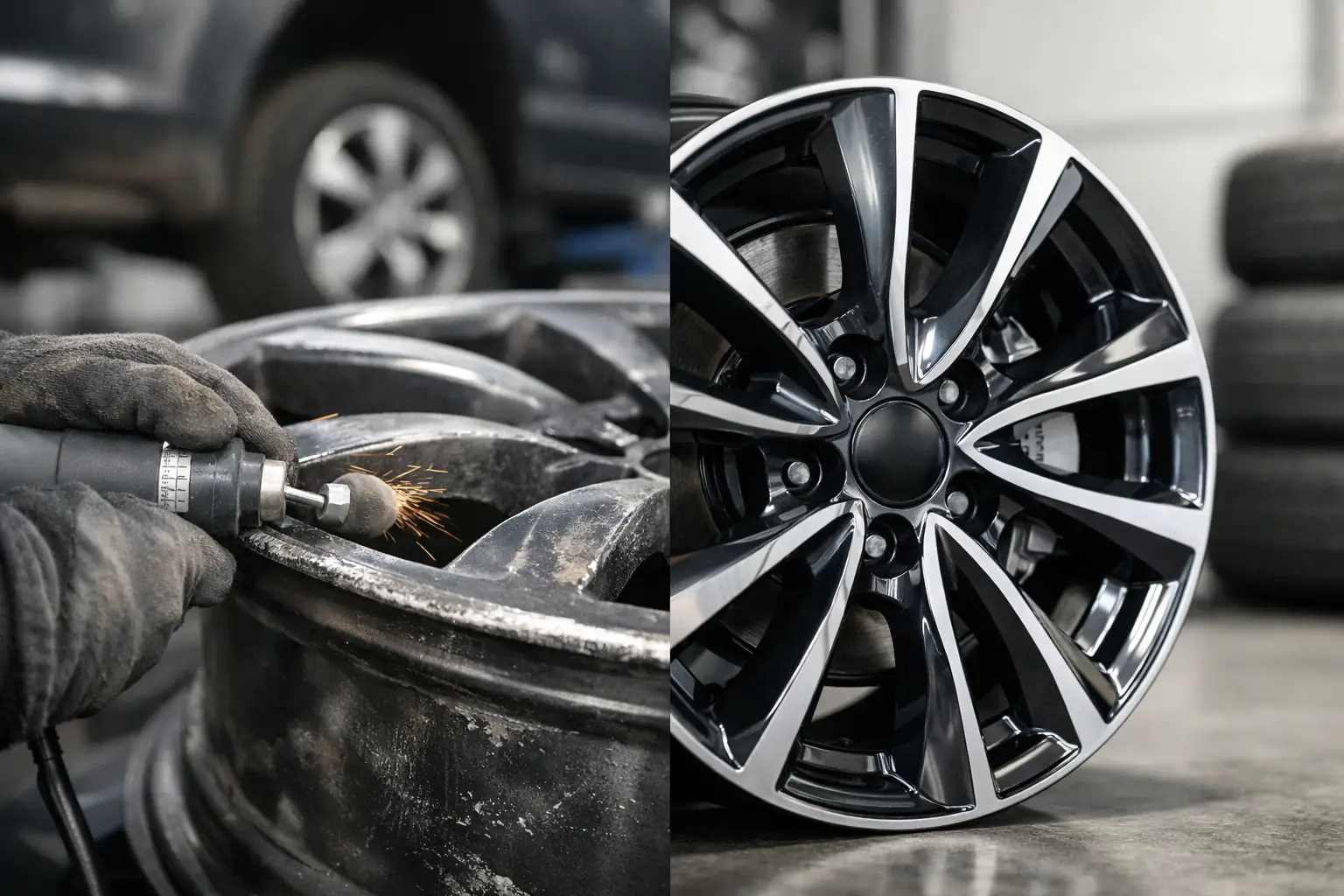
A kerbed alloy can spoil the whole look of a car in seconds. The bigger question is what comes next. When it comes to wheel repair vs replacement, the right answer depends on the type of damage, the wheel design, and whether the issue is cosmetic, structural, or both.
For many drivers, replacement feels like the safest option because it sounds straightforward. In reality, that can mean higher cost, longer lead times, and a poor match against the remaining wheels if the finish has aged. Repair, on the other hand, can be the smarter route – but only when the work is carried out by a proper specialist with the equipment and experience to assess the wheel correctly.
Wheel repair vs replacement: what actually decides it?
The decision is not simply about price. A wheel should only be repaired if it can be restored safely and to a high standard. That means inspection comes first, not guesswork.
Cosmetic damage is usually the clearest case for repair. Kerb marks, lacquer peel, corrosion, scuffs and tired finishes can often be removed through refurbishment, leaving the wheel looking close to factory fresh. If the wheel is otherwise sound, replacing it would often be an unnecessary expense.
Structural damage needs a more careful view. A minor buckle or certain types of crack may be repairable, but only after proper assessment. The location, severity and extent of the damage all matter. Some wheels can be restored safely using specialist in-house processes. Others should be replaced because the damage is too severe or sits in an area where repair would not be appropriate.
This is where experience matters. Low-cost, quick-fix operators may focus on appearance alone, but a specialist workshop should be looking at the wheel as a complete component – finish, shape, integrity and long-term reliability.
When wheel repair is the better choice
In most everyday cases, repair makes very good sense. If your alloy has been kerbed in a car park, picked up corrosion around the rim, or lost its original finish through age and brake dust, refurbishment can restore the appearance without the cost of sourcing a new wheel.
That is especially true for diamond cut alloys. These wheels need a precise machining process to recreate the sharp, bright face of the metal before the lacquer is applied. When this work is carried out in-house by a specialist, the result is usually far superior to a superficial cosmetic touch-up. The same applies to painted, powder coated and custom finished wheels where colour match and prep quality make all the difference.
Repair also makes sense when replacement is awkward. Some original wheels are expensive, discontinued, or difficult to source quickly. On premium and performance vehicles, a single new alloy can cost far more than drivers expect. If the damaged wheel is repairable, refurbishment can deliver a strong result while keeping the set consistent.
There is also the matter of value. A professionally refurbished wheel can improve the look of the car, support resale presentation and help avoid the obvious mismatch that sometimes comes from fitting one brand-new wheel next to three older ones.
When replacement is the right call
There are cases where replacement is the only sensible option. If a wheel has suffered significant structural damage, a specialist may advise against repair. That could include severe cracks, major distortion, or damage in areas where safe restoration cannot be guaranteed.
Repeated damage can be another factor. If a wheel has already been repaired before, particularly if the wheel has been heavily buckled or cracked more than once, replacement may be the more dependable long-term choice. At that stage, preserving the wheel is less important than restoring confidence in the vehicle.
Replacement may also be worth considering if the wheel is low value and easy to source. On some mainstream models, a good replacement wheel may be competitively priced, making the decision more balanced. Even then, finish quality matters. A used wheel with hidden corrosion or previous poor repair work is not always the bargain it first appears to be.
The real cost of wheel repair vs replacement
Price is usually the first thing drivers ask about, but the cheapest route is not always the best value. A quick cosmetic repair at low cost can look acceptable for a short period, then fail through poor preparation, weak lacquer or incomplete corrosion treatment. That often means paying twice.
A proper refurbishment is more involved. The wheel should be stripped, prepared thoroughly, repaired where suitable, refinished with the correct process, and checked carefully before it goes back on the car. That level of workmanship costs more than a smart repair van with a paint gun, but it delivers a very different standard of result.
Replacement sounds simple, yet it can become expensive once you factor in sourcing, finish matching, tyre removal and refitting, balancing, and in some cases dealer pricing. If the replacement wheel differs slightly in shade or wear from the others, the final look may still fall short.
For that reason, the real comparison is not just repair versus buying another wheel. It is specialist repair versus the full cost, time and uncertainty of replacement.
Safety should never be guessed
A damaged wheel is not just a cosmetic problem if it affects the structure. Vibration through the steering, air loss, visible distortion or impact damage after a pothole strike all need proper inspection.
This is where workshop-based capability matters. A specialist service should assess whether a buckle can be corrected, whether a crack repair is suitable, and whether the wheel can return to service with confidence. If the answer is no, you should be told clearly. A reputable business does not force a repair where replacement is the safer route.
That honest assessment is often what separates specialist refurbishment from general repair services. The standard should be simple: if a wheel can be restored properly, do it well. If it cannot, replace it.
Finish quality matters more than most people expect
Many customers start by wanting the damage gone. What they really notice afterwards is the finish. Does the wheel match the other three? Is the lacquer smooth? Does the diamond cut face look crisp? Has the corrosion been dealt with properly, or just covered?
These details matter on every car, but they stand out even more on premium vehicles where wheel design is part of the overall look. An Audi, BMW, Mercedes AMG or Porsche with one visibly mismatched alloy never looks quite right. Equally, an everyday car benefits just as much from careful refurbishment because neat, clean wheels change the whole appearance of the vehicle.
That is why in-house processes are so important. When the work is controlled by the same specialist team from start to finish, quality tends to be more consistent. Auto Wheels Ltd has built its reputation on exactly that approach, combining technical capability with OEM-quality finishes and warranty-backed workmanship.
How to make the right decision for your wheel
Start with the type of damage. If it is cosmetic, repair is usually the obvious place to begin. If there is a crack, buckle, vibration or suspected impact damage, get the wheel inspected before making any decision.
Then consider the wheel itself. Is it a premium factory wheel, a difficult-to-source design, or part of a set where matching matters? If so, repair often offers stronger value. If the wheel is badly damaged and a direct replacement is easy to obtain, replacement may be more practical.
Finally, choose the standard you want. If you care about finish quality, durability and safety, avoid judging the job on price alone. Specialist refurbishment is not the same as a quick cosmetic patch, and the result should not be compared as if it is.
A good wheel specialist will tell you where repair makes sense, where replacement is wiser, and why. That is the advice worth paying attention to. The best outcome is not the cheapest line on paper – it is the one that leaves you with a wheel you can trust and a car that looks right every time you walk back to it.