
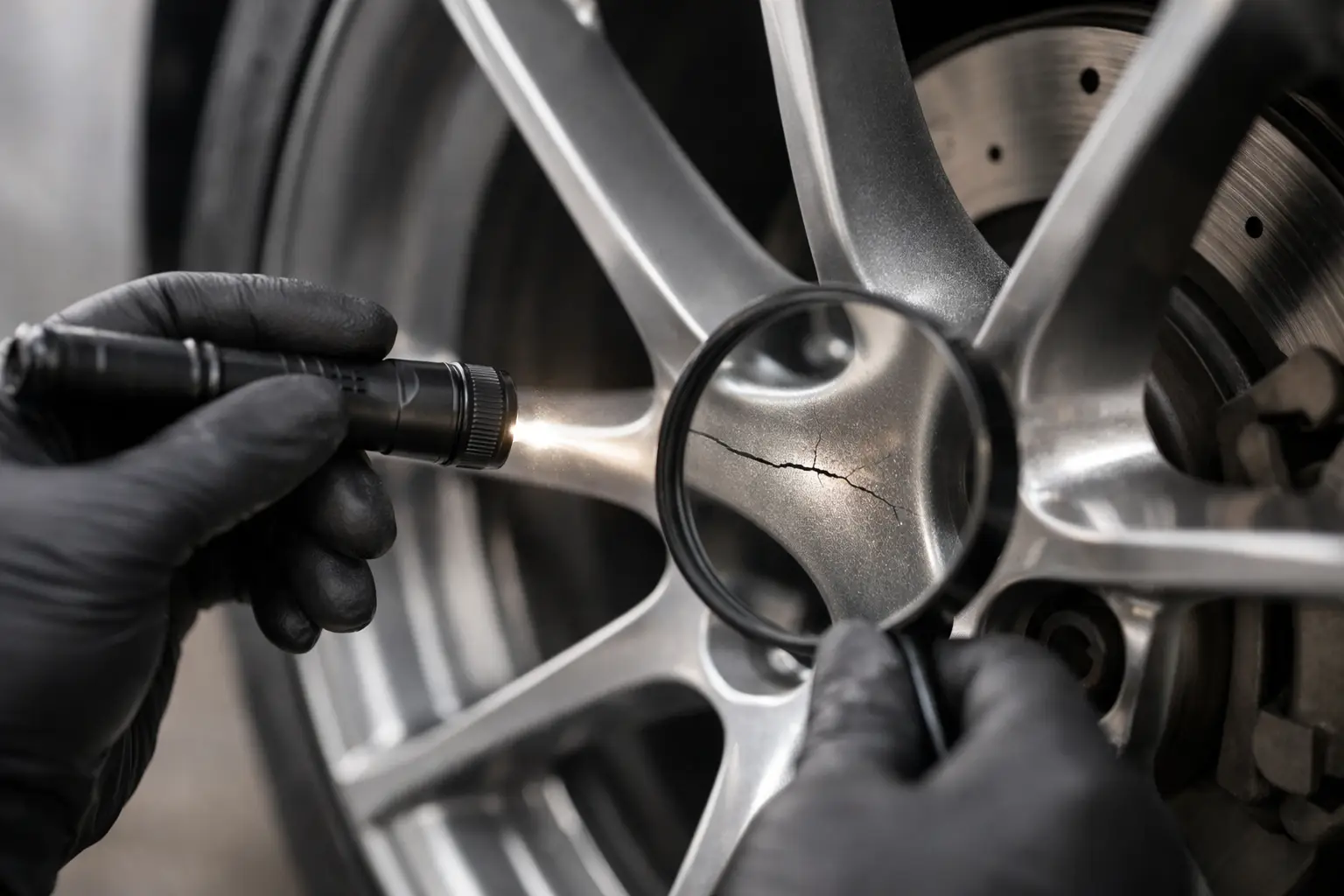
A wheel can look presentable from a few feet away and still have a crack serious enough to affect safety. That is why knowing how to spot wheel cracks matters. Catching the problem early can mean the difference between a straightforward repair and a wheel that is no longer fit for the road.
Cracks are not always obvious. Some sit on the inner barrel where you will not see them during a quick walkaround. Others start as fine hairlines around the spokes or rim edge and only become visible once brake dust and road grime are cleaned away. If your car has started losing tyre pressure, vibrating through the steering wheel or feeling unsettled over bumps, the wheel deserves a proper inspection.
How to spot wheel cracks before they get worse
The first step is to stop relying on appearance alone. A cracked alloy wheel does not always look badly damaged, especially if the impact that caused it seemed minor at the time. Potholes, poor road surfaces, raised drain covers and kerb strikes can all create damage that develops gradually.
Start with the simplest question. Has anything changed in how the car drives? A wheel crack often shows itself through symptoms before you ever see the damage. Repeated low tyre pressure on one corner, a vibration that was not there before, or a slight wobble at motorway speeds can all point to a structural issue. Those signs do not automatically mean a crack, because buckles, tyre damage and balancing problems can feel similar, but they are a clear reason to inspect the wheel properly.
A visual check should always begin with a clean wheel. Dirt hides fine fractures very effectively. Wash the face, the inner barrel if accessible, and the area around the valve. Look closely at the inner edge of the rim, the base of the spokes and the area where the spokes meet the hub. These are common stress points on alloy wheels.
Hairline cracks often appear as thin dark lines that do not wipe away. They may look slightly jagged rather than perfectly straight. If the line sits in the lacquer or paint only, it may be cosmetic. If it follows through the metal, particularly near the rim edge or inner barrel, that is much more serious. If you are unsure, do not guess. Structural damage needs specialist assessment.
The warning signs drivers often miss
Many motorists expect a cracked wheel to cause an immediate and dramatic problem. Sometimes it does. Just as often, the signs are subtle.
Slow pressure loss is one of the most common. If you are topping up one tyre far more often than the others and there is no obvious puncture, the wheel could be leaking through a crack. This is especially common with inner barrel cracks, which can be hard to spot while the wheel is still on the vehicle.
Another sign is vibration through the steering wheel, seat or cabin floor. Again, this is not exclusive to cracks. It could also be a buckle, tyre issue or suspension problem. The point is that a wheel should be ruled out quickly, because continuing to drive on a cracked alloy can make the damage worse.
You may also notice a knocking feeling over rough surfaces, a change in handling, or a tyre that repeatedly triggers the pressure monitoring system. On premium and performance cars with lower-profile tyres, impacts are transmitted more directly to the wheel, so the risk can be higher even if the tyre itself looks acceptable.
Where cracks usually appear
Most alloy wheel cracks are found in a few predictable areas. The inner barrel is a common location because it takes impact forces from potholes and is less protected than many drivers realise. The outer rim edge can also crack after kerb damage or a heavy strike.
Cracks around the spokes deserve particular attention. These areas carry load and can be subject to repeated stress. A cosmetic mark on a spoke is one thing. A fracture in the metal is very different and should never be ignored.
If the wheel has been refurbished before, inspection needs to be even more careful. A quality refurbishment does not create cracks, but old damage, poor previous repairs or hidden structural issues can become more obvious over time.
A simple at-home check
If you suspect a problem, do a basic inspection before driving any further than necessary. Turn the steering to expose the inside of the front wheel as much as possible and use a bright torch. On the rear, visibility is more limited, so a proper workshop inspection may be needed.
Look for fresh metal marks, hairline splits, staining around a crack, or any area that seems to have a line running through the finish and into the alloy. Listen too. If you inflate the tyre and hear a faint hiss near the wheel, that can indicate escaping air. Do not put your face close to the wheel while checking, and do not rely on sound alone.
What you should not do is keep driving while hoping it sorts itself out. Even a small crack can spread. Heat cycles, road impacts and normal load from daily driving all add stress. A wheel that was repairable this week may be beyond safe repair later if it is left in service.
How professionals confirm a cracked wheel
Knowing how to spot wheel cracks is useful, but confirmation should come from a specialist. In a proper workshop setting, the tyre can be removed and the wheel inspected fully inside and out. That matters because many cracks are impossible to assess accurately with the tyre fitted.
A specialist will check not only whether the wheel is cracked, but where the crack is, how far it extends and whether the wheel has any accompanying buckle or distortion. That detail matters. Some cracks can be repaired safely by an experienced workshop using the correct process and equipment. Some cannot.
This is where there is a real difference between a specialist service and a quick cosmetic fix. Structural wheel work is not just about making the damage less visible. It is about whether the wheel can be restored to a safe standard. If the crack is in an unsuitable area, too extensive, or combined with other damage, replacement may be the right answer.
Repair or replace?
There is no honest one-size-fits-all answer. It depends on the wheel design, the crack location, the extent of damage and the wheel’s overall condition.
A small crack in a repairable section of the wheel may be dealt with effectively by a specialist. A crack near a spoke mounting area or a wheel with multiple fractures may not be a sensible candidate for repair. Likewise, a cheap replacement is not always the best option if it compromises quality, but neither is attempting to save a wheel that should be retired.
The right approach is a clear assessment based on safety first, finish quality second and cost third. That is the order any reputable wheel specialist should work in.
Why cracked wheels are more common than people think
UK roads are not kind to alloy wheels. Potholes, uneven surfaces and urban kerbing all take their toll. Heavier vehicles and larger wheel diameters add another layer. Modern cars often run bigger alloys with lower-profile tyres, which look superb but offer less cushioning against impact.
That does not mean every wheel is fragile. It means the margin for absorbing a bad road strike can be smaller than many drivers expect. A premium vehicle is not immune either. In fact, owners of higher-performance cars often see wheel issues because the combination of wheel size, tyre profile and vehicle weight can be demanding.
For trade customers and dealerships, this is one reason wheel inspection matters so much during vehicle preparation. A wheel can pass a casual glance and still have an issue that affects drivability and customer confidence.
When to stop driving immediately
If the tyre is losing pressure rapidly, the crack is visible, or the car feels unstable, stop using it until it has been checked. The same applies if you have had a significant pothole impact and the car immediately develops vibration or a handling change.
Driving carefully for a short distance to a local specialist may be possible in some cases, but it is not something to assume is safe without judgement. A cracked wheel is a structural defect, not a cosmetic inconvenience.
At Auto Wheels Ltd, wheels are assessed with exactly that mindset – safety, precision and proper workshop standards first. That is what gives drivers confidence in the result, whether the outcome is repair or replacement advice.
A cracked wheel rarely fixes itself and rarely stays the same for long. If something feels off, trust that instinct, get the wheel inspected properly, and deal with the issue before a small fault turns into a far more expensive one.